The methodology
A practitioner is a whole person.
So is a client. Everything taught here starts from that assumption and works outward.
A working principle
Neurodivergent-friendly by design
A great many of the most gifted stylists in the working trade think in ways that conventional cosmetology school does not accommodate. The program is built differently from the beginning — not as an accommodation bolted on at the end, but as the foundation.
Roughly one in five people is neurodivergent. In a hands-on trade that rewards visual-spatial thinking, hyperfocus, and a high tolerance for sensory detail, that share is almost certainly higher.
The Collective’s curriculum is built on the research on how those brains actually learn: chunking work into short, finishable tasks; pairing every written passage with a demonstration and a hands-on practice; teaching the same idea in three different forms so the one that fits a particular brain is always in reach.
Modules have visible endings. There are rest cues. There are no surprise quizzes. Assessment is open-book and skill-based, because in the salon the book is always open.
Typography and layout follow the British Dyslexia Association style guide1: rounded sans-serif body type, generous line spacing, left-aligned text, and a soft off-white background instead of pure white. Reading level and font size are adjustable. Audio narration accompanies every reading.
None of this lowers the standard. It clears the noise so the standard can be met by the person actually doing the work.
- Short modules with visible endings, chunked work, and instant feedback.
- The same concept presented in text, demonstration, and hands-on practice — as a sequence.
- Dyslexia-friendly typography: rounded sans-serif, 1.5× line height, left-aligned, off-white.
- Audio narration on every reading, with playback speed control.
- Open-book, skill-based assessment. No timer. No surprise quizzes.
- Quiet practice hours, sensory accommodations, and the option of a private review.
Fig. IV · Scalp microcirculation
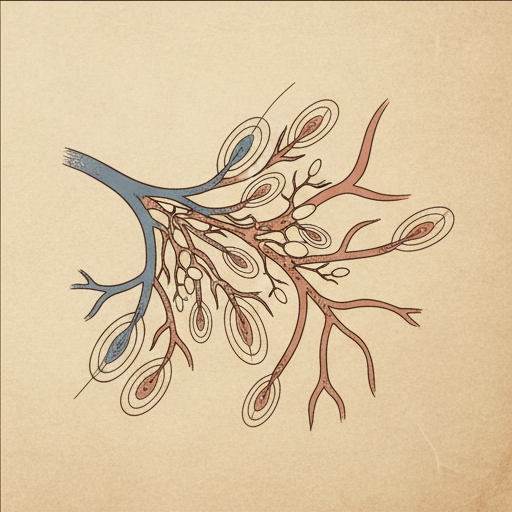
- Arteriole
- Capillary bed
- Venule
A working knowledge of the body
Osteopathic awareness
Hair is grown from a body. Stylists work on the head, neck, and upper spine for hours at a time, and stand on their own feet for the rest of it. Both bodies in the room deserve consideration.
The Collective’s osteopathic-awareness work begins with the scalp as a layered, engineered structure rather than a sheet of skin. The five layers an acronym (S-C-A-L-P) describes — skin, dense connective tissue, aponeurosis, loose areolar tissue, pericranium — behave differently under a stylist’s hands.
Knowing which layer slides changes how a scalp massage actually works. Knowing where the galea aponeurotica2 goes tight under chronic jaw clenching changes how a stylist reads a client.
From there the curriculum moves into the fascial chains that connect the scalp to the shoulders, the shoulders to the low back, and both bodies in the room to each other. The cervical spine and how it tolerates a wash bowl. Shoulder mechanics for blow-drying, where the rotator cuff fails first. The shear grip and the thumb tendon. The cumulative load of standing for an eight-hour day in the wrong shoes.
The career-ending injuries that arrive at year ten are predictable, and prevention is most of the work. None of this is a substitute for medical care. It is the working knowledge of the body that anyone who touches another person for a living should have.
Fig. V · Hair shaft, in section
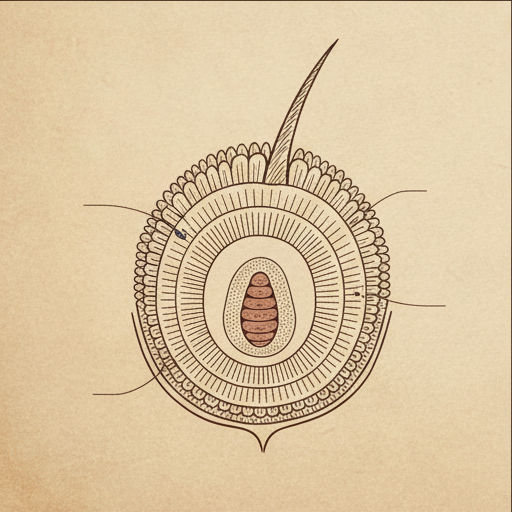
- Cuticle
- Cortex
- Medulla
A working commitment
The ethics of holistic practice
A holistic practice is not a marketing posture. It is a set of working commitments:
- That the scalp is part of the body, and treating it that way is not optional.
- That a stylist’s health is part of the salon’s health.
- That informed consent and honest pricing belong in this trade, the way they belong in every other one.
- That clients are not customers to be optimized. They are people whose hair is sometimes the most personal thing they let another person touch.
- That an apprentice is not free labor. They are the future of the practice.
Sustainability as a clinical subject
The practitioner as whole person
The Collective expects a stylist to have a long career. For that to be true, the work has to be sustainable: physically, financially, and emotionally. The methodology treats stylist wellbeing as a clinical subject, not a wellness aside.
Posture, ventilation, voice care, time off, fair pay, retirement — these are part of the curriculum, because a salon without them will not last.
- 1. British Dyslexia Association, Style Guide: rounded sans-serif body, 1.5× line height, left-aligned (never justified), soft off-white background. Followed throughout.
- 2. Galea aponeurotica — the tendinous sheet that connects the frontalis and occipitalis muscles across the top of the skull. Tightens with chronic jaw clenching, and is the structural reason a stylist’s hands can feel a client’s tension from temple to crown.